
Shawaz (Arabic: شواظ) are a series of off-route anti-tank (AT) mines, produced and used by the Izz al-Din al-Qassam Brigades of Hamas. Between 15 October 2023 and 7 October 2025, METIS recorded a total of 110 sightings or uses of a Shawaz.

OSINT investigation
Using METIS, Fenix Insight’s expert OSINT software, to understand the Shawaz off-route Anti-Tank family
What are Shawaz off-route Anti-Tank mines?
Shawaz (Arabic: شواظ) are a series of off-route anti-tank (AT) mines, produced and used by the Izz al-Din al-Qassam Brigades of Hamas.
Each of these mines utilise explosively formed projectiles (EFPs) to attack armour. They can be affixed to a tripod or laid on/against a surface, and are typically directly placed against IDF tanks in Gaza, placed at roadsides, or deployed vertically from tunnels to conduct a belly attack.
There are believed to be eight top-level models that have been developed, with further variants within these. However, only limited variants have been seen deployed in Gaza in the recent conflict, indicating an effort to standardise manufacturing. Even within the eight variants there is inconsistency in the designations and typically they are all referred to as ‘Shawaz’. These are often referred to as ‘improvised explosive devices’ (IEDs). However, due to the large numbers seen fielded, along with the consistency in design and operation, a more accurate term would be ‘locally-manufactured’.
For more information on their development, design, deployment, specification, alternate designations (including nicknames), and relationship to other munitions click here.

When was the Shawaz off-route Anti-Tank mine first recorded in METIS?
The first usage of a Shawaz device was reported by the Jenin Battalion wing of the Al-Quds Brigade, who claimed to have used one against an Israeli Defence Force (IDF) vehicle in Jenin during operation Home and Garden on the 4th of July 2023. However, as the available imagery does not show a munition, our in-house analysts are unable to confirm whether a Shawaz device was used in this attack.
The first recorded sighting of a Shawaz device in METIS occurred on 15 October 2023, when the IDF released images of a captured Hamas munition cache containing Shawaz mines, along with a variety of other weaponry. This event was recorded in METIS, with further analysis and insight provided by in-house technical experts.
15th of October 2023 |
‘IDF finds Hamas weapons and intelligence files in southern Israel. As the ongoing conflict between Israel and Hamas in Gaza persists, the Israel Defense Forces (IDF) has revealed the discovery of a significant intelligence cache from the Hamas assault on southern Israel. Within this cache, there lies a wealth of crucial information, including operating manuals for Hamas militants, operational plans, satellite phones, contact methods, and encrypted numbers linked to the terrorist organization.’ |
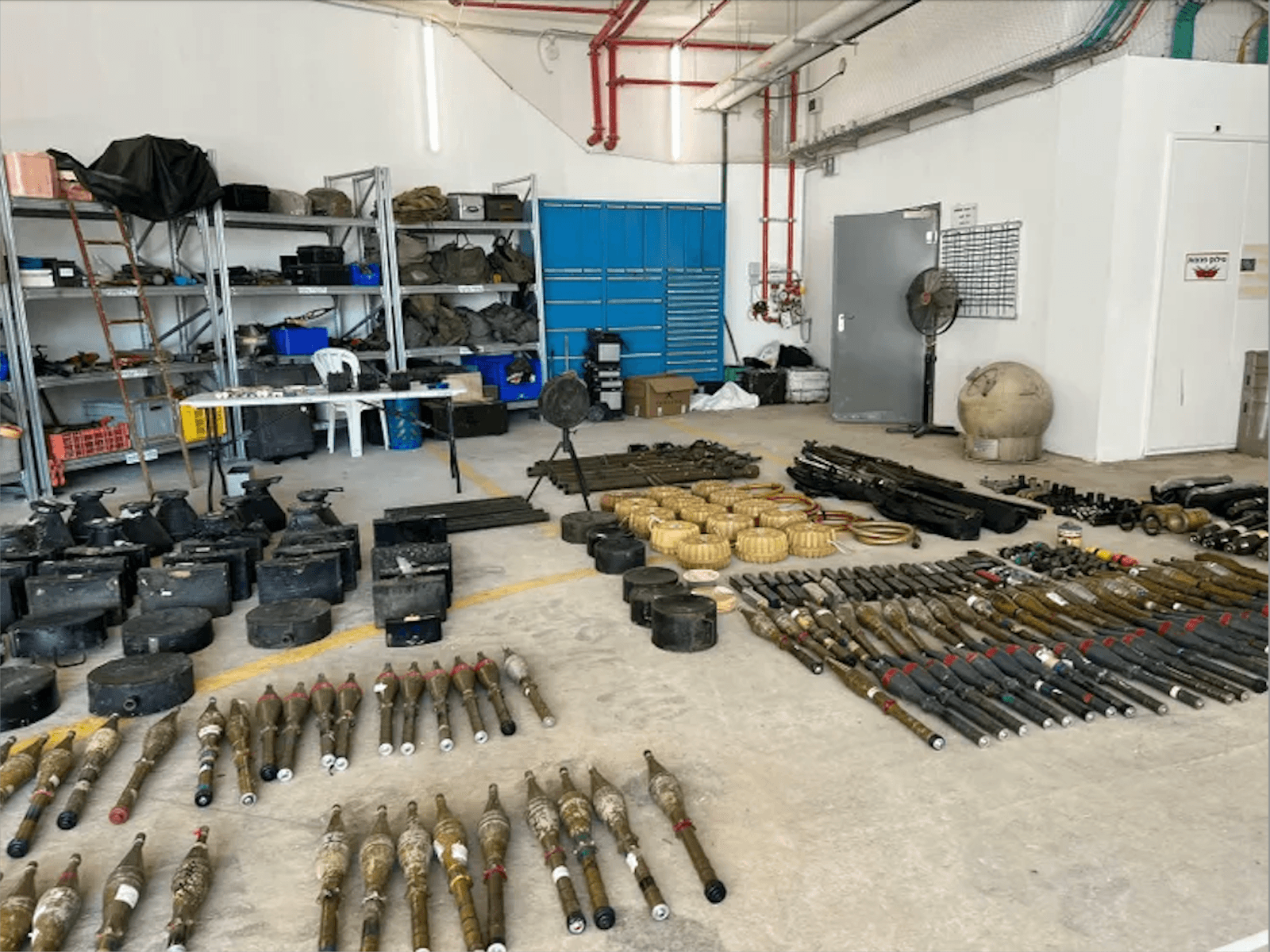 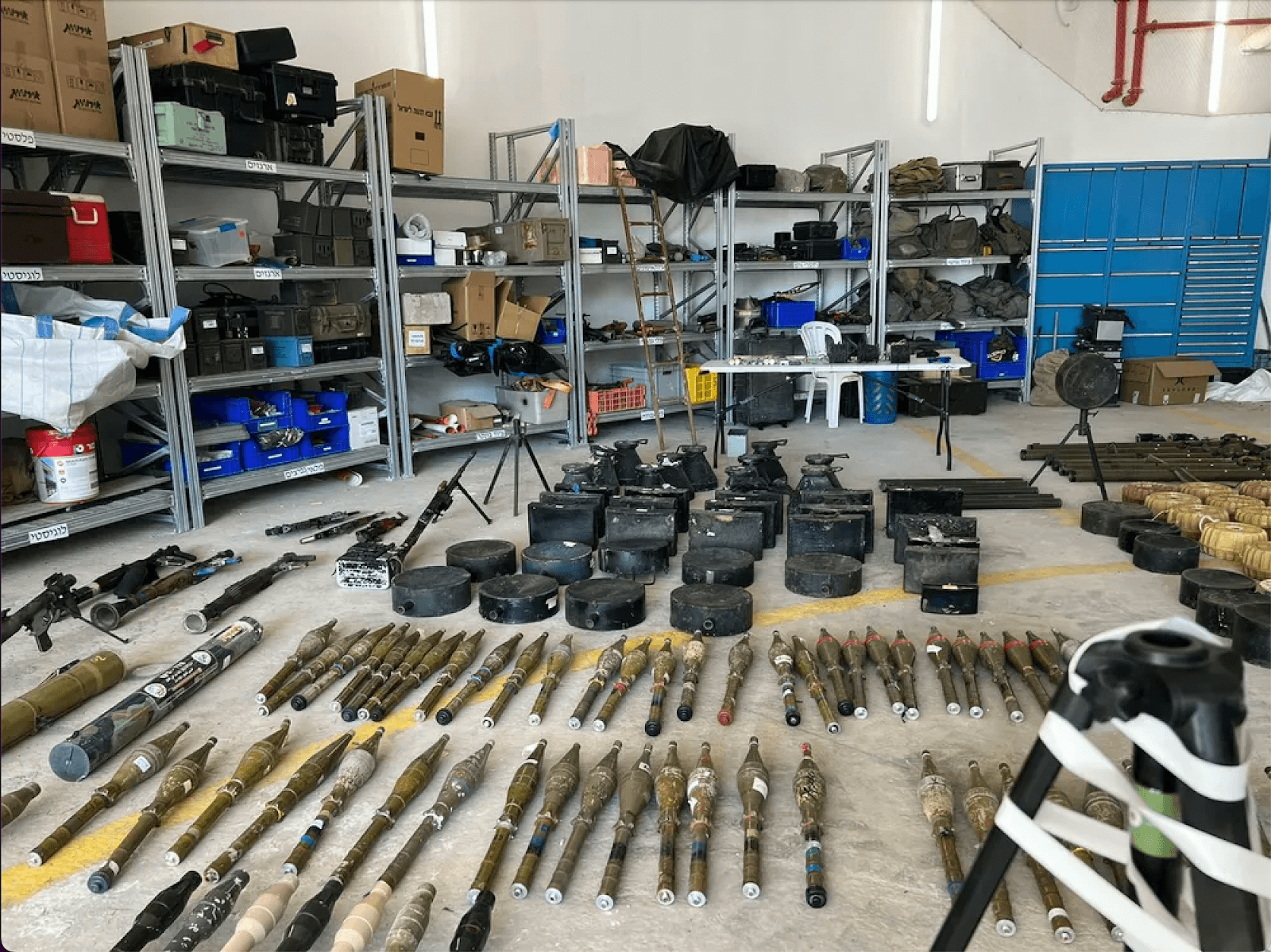 |
The first recorded operational use in METIS was on 13 December 2023, when Hamas militants employed a Shawaz mine to target three Israeli tanks in Beit Lahiya. Between 15 October 2023 and 7 October 2025, METIS recorded a total of 110 sightings or uses of a Shawaz. Each event entry includes the information source, location, date, and description, along with a link to the corresponding technical records of munitions identified in the event, related events, and observed trends over time.
By far, the most common variant of Shawaz used is the Shawaz-3, which itself is a sub-variant of the original Shawaz-8. This is not to be confused with the original Shawaz-3 which no longer appears to be fielded. This has a relatively simple conical body with a base plate and carry handle. It is base-fuzed and has a reported explosive mass of 3.5 kg. The claimed penetration against mild steel is 650-700 mm, however this is unverified.
Identification of the Shawaz variants in METIS has been based on photographic or videographic source imagery analysed by in-house experts. While many other instances of ‘Shawaz’ usage have been captured, but without the ability to identify the exact variant used. As such, it is likely that the Shawaz-3 is involved in more events than can be analysed. Hamas’ usage of Shawaz mines in Gaza may also be more widespread, but due to the lack of verifiable evidence, as well as the Shawaz being routinely identified simply as an IED in reported incidents, it is not possible to confirm this.
Barq variant
The Barq (Arabic: برق,, English translation: "Lightning") is both a variant of the Shawaz off-route mines, but also the anti-personnel projected rifle grenade which shares its name. It can be seen as both an improved variant of the Shawaz, and of the Barq grenade, due in part to the change in Hamas tactics during 2025. The instances of munitions being thrown into open hatches of vehicles during ambushes increased significantly, requiring a change in munition design as the Shawaz is too large to fit, and the Barq grenade is too imprecise.
Whilst they have been seen directly placed at roadsides or placed on/near to static vehicles, the primary targeting method appears to be throwing them into open hatches, allowing it to detonate internally. This typically causes significant damage and casualties, assumed to be in excess of the original Shawaz mines, which have been seen to cause damage but are unconfirmed in the number of mobility and complete vehicle kills achieved.
The Barq has been identified in 9 events in METIS since the first confirmed sighting on 25 June 2025. As with the Shawaz and its variants, usage of the Barq by Hamas may be more prolific, but some instances may have been reported simply as an IED or lack verifiable visual evidence.
25th of June 2025 |
#Palestine / #Israel 🇵🇸🇮🇱: "Al-Qassam Brigades" (#HAMAS) ambushed #IDF Armored Vehicles and Killed 7 Israeli Soldiers in Khan Yunis, #Gaza. |
In summary, METIS analysis shows that the Shawaz family represents a structured and increasingly standardised set of locally manufactured anti-tank munitions, with the Shawaz-3 most commonly observed. Despite limited verifiable data, recorded events indicate consistent use and ongoing adaptation, including the emergence of the Barq variant to meet evolving tactical needs.
Want to learn more about the Shawaz off-route anti-tank family?
For detailed insight into these munitions and their recorded usage, contact us to request a comprehensive technical report, or arrange a METIS demo for access to the full detailed technical pages and related event data.
You may also be interested in
Related products & services
Fenix Insight’s unique combination of subject matter expertise, decades of field experience, extensive hardware collection and proprietary AI tools, provide a range of options that we can tailor into bespoke solutions for your needs.
Contact us to discuss your specific project requirements.

Latest
From the Blog
Stay informed with Fenix Insight's latest intelligence briefings, delivering timely updates on global security events and explosive ordnance developments.

